Empowering Your Team With the Right HR & Payroll Tools
Managing human resources can be one of the most time‑consuming and complex parts of running a small business. From payroll to onboarding, compliance to employee performance tracking — it’s easy to feel overwhelmed if you don’t have the right tools in place.
In 2026, HR software isn’t just “nice to have” — it’s essential. Whether you’re a bootstrapped startup with a handful of employees or a growing team approaching 50+, the right HR software platform can save you hours of administrative work, reduce costly compliance errors, and help you make smarter people decisions.
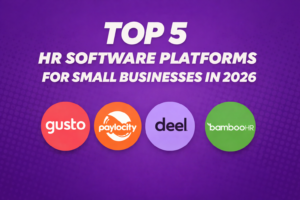
In this in‑depth guide, we’ll walk you through the Top 5 HR Software Platforms for Small Businesses in 2026 — comparing features, pricing, pros and cons, and what kind of business each is best for. And because we know small business owners value simplicity, transparency, and performance — we’ll help you pick what’s right for your team.
🧭 What Small Business HR Software Should Do
Before we dive into the top platforms, it’s worth clarifying what the best HR software should help you with. At a minimum, a modern HR solution for small businesses should:
✅ Automate payroll and taxes
✅ Manage employee records and onboarding
✅ Handle time tracking and PTO
✅ Support benefits administration
✅ Ensure compliance with federal and state laws
✅ Offer employee self‑service
✅ Integrate with other tools (like accounting or time‑clock apps)
In 2026, many HR platforms have also stepped up to include performance tools, recruiting capabilities, surveys, custom reporting, and mobile functionality — all of which help you build stronger teams and save time.
🌟 1. Gusto – Best All‑In‑One HR & Payroll Software for Small Businesses
👉 Best for: Small teams that want a single, easy‑to‑use HR solution that handles payroll, compliance, benefits, onboarding, and more.
If you’re running a small business and you want an HR platform that just works — without endless configuration or costly extras — Gusto is one of the best choices in 2026. Known for its intuitive interface and transparent pricing, Gusto helps businesses centralize payroll and HR in one platform.
💡 Key Features
-
Full‑service payroll with automated tax filing
-
Time tracking and PTO management
-
Onboarding tools with checklists and offer letters
-
Benefits administration (health, retirement, etc.)
-
Employee surveys and performance tools
-
Support for international contractors
-
Integrations with accounting, time management, and other HR tools
-
Customer support and optional HR expert guidance
🧠 Why Small Businesses Love It
Gusto is built for small business owners who want to simplify payroll and HR without needing an HR degree. Its dashboards are clean, onboarding flows are straightforward, and most features are included without costly add‑ons.
💰 Pricing (Typical Small Business)
-
Simple: $49/month + $6/employee/month
-
Plus: $80/month + $12/employee/month
-
Premium: Custom pricing
-
HR add‑on available for certified compliance alerts
💡 Affiliate CTA Opportunity:
If you decide Gusto is right for your business, start with their free trial and unlock a smoother payroll + HR experience. ➤ [Insert your Gusto affiliate link here]
📌 Pros & Cons
👍 Pros
-
Easy setup and use
-
Transparent pricing
-
Excellent payroll and compliance support
-
Comprehensive onboarding + benefits tools
👎 Cons
-
Mobile app has some limitations
-
Can get pricey as you add features
-
Premium benefits aren’t available in all states
📊 2. Paylocity – Best HR & Payroll Platform for Growing Teams
👉 Best for: Small businesses and mid‑size teams that want a scalable all‑in‑one HR system with strong payroll and workforce management.
Paylocity is one of the leading HR and payroll platforms — especially if your team is growing and you need a system that evolves with you. It combines payroll, talent management, time and labor tracking, HR tools, and more into one ecosystem.
💡 Key Features
-
Robust payroll processing
-
Time tracking and labor management
-
Performance and talent tools
-
Workforce analytics
-
Flexible integrations
-
Employee self‑service portal
-
Custom audits and reporting
🧠 Why It’s a Great Pick
Paylocity’s strength is its configurability. Larger small businesses (20–100+ employees) will appreciate the depth of workforce tracking, engagement tools, and automation.
💰 Pricing
Unlike simpler platforms, Paylocity pricing is typically custom based on company size and modules selected — so you’ll need to contact sales for an exact quote.
📌 Pros & Cons
👍 Pros
-
Excellent HR + payroll combo
-
Good for teams that expect to grow
-
Strong mobile and self‑service tools
👎 Cons
-
Pricing isn’t transparent
-
More complex to configure than entry‑level tools
-
Some features may be overkill for very small teams
🌍 3. Deel – Best for Global Payroll & Compliance
👉 Best for: Small businesses scaling internationally or managing global contractors and employees.
If your business works with international contractors or has employees in multiple countries, standard HR platforms may not cut it. Enter Deel — a platform built around global hiring, contractor payments, localized compliance, and payroll across borders.
💡 Key Features
-
Payroll and compliance in 150+ countries
-
Employer of Record (EOR) support
-
Contractor onboarding and payments
-
Localized contract templates
-
Time‑off and expense management
-
24/7 global support
🧠 Why It’s Unique
Most traditional HR software focuses on one country. Deel was built for the global age — so if you’re hiring remote workers in Europe, Africa, Asia, or South America, you get local compliance, curated contracts, and global tax handling.
💰 Pricing
Deel’s plans usually start per employee/contractor/month and scale with services chosen. They typically have:
-
Base global services
-
Add‑ons for benefits, background checks, and EOR
📌 Pros & Cons
👍 Pros
-
Outstanding global payroll features
-
Local compliance and contract support
-
Great for scaling teams
👎 Cons
-
More expensive for single‑country businesses
-
Not always a full HRIS on its own
🧠 4. BambooHR – Best HRIS for Employee Experience & Culture
👉 Best for: Small teams that want strong HR tools focused on employee lifecycle, engagement, and performance.
Not all businesses need the same kind of HR software. If your HR priorities lean toward employee records, onboarding workflows, performance tracking, and culture building — BambooHR is worth a look.
💡 Key Features
-
HR record management and data centralization
-
Onboarding and offboarding automation
-
Performance reviews and feedback
-
Custom reporting
-
Optional payroll and benefits add‑ons
-
PTO and leave tracking
🧠 Why It’s a Strong Choice
BambooHR isn’t just about payroll. It excels at the people side of HR — including engagement, performance, and organizational insights.
💰 Pricing
BambooHR pricing is typically quote‑based and can start around modest monthly rates for small teams — but you may need to purchase payroll and add‑ons for a full HR/payroll suite.
📌 Pros & Cons
👍 Pros
-
Excellent employee management tools
-
Strong onboarding and performance tracking
-
Clean, intuitive interface
👎 Cons
-
Payroll is an add‑on (additional cost)
-
Not as comprehensive out of the box for payroll
⏱️ 5. Homebase – Best for Hourly Worker Scheduling & Shift‑Based HR
👉 Best for: Small businesses with hourly staff (e.g., restaurants, retail, hospitality).
If your company runs on hourly schedules — with rotating shifts and tight labor‑cost oversight — Homebase deserves a spot on your shortlist. It brings together scheduling, time tracking, and payroll within an easy, mobile‑ready platform.
💡 Key Features
-
Auto scheduling and shift swaps
-
Time clocks with geofencing
-
Team messaging
-
Payroll add‑on with tax filing
-
PTO tracking
-
Mobile apps for managers and employees
🧠 Why It Works for Hourly Teams
Homebase is built for simplicity and scheduling accuracy — not enterprise HR complexity. For small retail shops, restaurants, and on‑site teams, this is one of the most cost‑effective solutions available.
💰 Pricing
Plans range from a free basic option (with scheduling and time clocks) through paid tiers that include full HR tools and payroll add‑ons.
📌 Pros & Cons
👍 Pros
-
Excellent shift scheduling tools
-
Free tier available
-
Great mobile experience
👎 Cons
-
Not a full HRIS unless you upgrade
-
Payroll costs extra
🪄 Choosing the Right HR Software for Your Business
Selecting HR software isn’t one‑size‑fits‑all. Here’s how to match your needs with a platform:
🧾 You Want Simple Payroll + HR
👉 Gusto — best balance of ease, features, and cost.
📈 You’re Growing Fast
👉 Paylocity — strong payroll + HR tools for scaling teams.
🌍 You Hire Internationally
👉 Deel — built for multi‑country hiring and compliance.
🧑💼 You Care About Culture & Engagement
👉 BambooHR — focused on employee experience.
🕒 You Run Hourly & Shift Work
👉 Homebase — schedule‑first HR solution.
🧩 Tips for Choosing the Best HR Software
✅ Think about your current pain points — is it payroll accuracy? scheduling? compliance?
✅ Estimate your growth trajectory — will you need more advanced HR tools soon?
✅ Check for integrations with your accounting or time apps
✅ Evaluate the learning curve — will your team adopt it easily?
✅ Ask for a demo or free trial before committing
⚡ Final Recommendation
For most small businesses in 2026, Gusto stands out as the best all‑around HR and payroll solution — offering robust features, user‑friendly design, transparent pricing, and scalable tools that grow with your business.
👉 Start with Gusto’s free trial today and see how much easier HR can be.
📍Insert your affiliate link here